Himalayan Pink Salt in a Supplement — Trace Minerals, Salt Rooms and Sodium
Quick Answer: What Does Himalayan Pink Salt Do in a Supplement?
Chemically, very little that ordinary salt would not. Pink salt is roughly 98% sodium chloride; the colour comes from trace iron oxide, and the much-advertised "84 trace minerals" are present at levels far too low to contribute meaningfully to nutrition — you would need a medically dangerous amount of salt to get a useful dose of anything else. In a respiratory formula its real job is associative: it borrows the reputation of halotherapy, salt-room therapy, which involves breathing aerosolised salt rather than swallowing it.
- Composition: ~98% NaCl plus trace minerals at nutritionally irrelevant levels.
- Halotherapy: inhaled dry salt aerosol. Thinly evidenced, and a completely different route.
- Watch for: sodium, if you have been told to limit it.
What pink salt actually is
Halite mined in Pakistan, tinted by trace iron oxide. Analyses put it at roughly 98% sodium chloride, with the remainder made up of small quantities of calcium, magnesium, potassium and a long tail of elements present in parts per million. The marketing figure of "84 trace minerals" is not fabricated — a sensitive enough instrument does detect a great many elements — but a number of species detected is not a nutritional claim. To obtain a meaningful amount of magnesium from pink salt you would have to eat far more salt than is safe.
Worth adding: unlike ordinary table salt, pink salt is generally not iodised. In populations that rely on iodised salt for iodine intake, switching entirely to pink salt is a small but real nutritional downgrade.
Halotherapy, and why the route matters
Salt rooms and salt caves deliver a fine dry sodium chloride aerosol into the air, which is then breathed. The proposed mechanisms are local: osmotic thinning of mucus, an effect on ciliary clearance, mild anti-inflammatory action on the airway lining. The evidence base is small, mostly low-quality, and reviewers consistently conclude that better trials are needed before recommending it.
But whatever halotherapy is or is not doing, it is doing it in the airway. Swallow a capsule containing salt and it goes to your stomach, dissolves, and is absorbed as sodium and chloride into the bloodstream like any other dietary salt. There is no mechanism by which that reproduces an inhaled local effect. Hypertonic saline nebulisers — which are a genuine clinical tool in cystic fibrosis and some bronchiectasis care — make the same point from the other direction: they work because they are inhaled, under supervision, at a specific concentration.
Three salt claims, ranked
| Claim | Standing |
|---|---|
| Nebulised hypertonic saline aids mucus clearance in specific conditions | Real, clinical, prescribed — and nothing to do with a capsule |
| Halotherapy may ease some respiratory symptoms | Weakly evidenced, actively debated, inhaled route |
| Swallowed pink salt supports the airways | No mechanism and no evidence |
The sodium question
The amount of salt in a capsule blend is small compared with a meal, so this is not usually a safety issue. It is still worth knowing about if you have been told to watch sodium — for blood pressure, heart failure or kidney disease — because "Himalayan pink salt" on an ingredient list is salt, and a blend that does not disclose amounts cannot tell you how much — which is exactly the situation the NIH Office of Dietary Supplements tells you to treat sceptically. And in a blend where components are listed in descending order, a bulk mineral sitting at the top of the list is not a trivial component. That descending-order rule is the only real lever you have on an undisclosed blend, and the arithmetic of 600 mg split eleven ways shows how far it actually gets you.
It is also worth knowing that a mark or a recall is not the end of a product's shelf life: an analysis in JAMA, 2022 found supplements named in FDA warning letters frequently remained on sale afterwards, so the burden of checking a label stays with you.
How to read it on a label
Treat pink salt as a flavour, bulking or carrier ingredient unless the manufacturer explains otherwise, and do not let its presence stand in for a respiratory mechanism; NCCIH makes the same point about traditional-use botanicals generally. If the salt-room idea appeals to you, the honest version is to go to a salt room — or, if you have a diagnosed condition where mucus clearance matters, to ask your clinician about nebulised saline, which is the version of this idea with actual evidence behind it. Pink salt also arrives wrapped in language about clearing or flushing the airways, which is the same territory as what an herbal lung detox can and cannot do. And it is not the only ingredient in a respiratory blend whose evidence base sits somewhere else entirely — lutein and zeaxanthin are macular pigments that reach lung formulas by exactly the same logic.
Medical note: general information, not medical advice. If you have been advised to restrict sodium, check any supplement containing salt with your clinician. Never substitute a supplement for prescribed respiratory treatment.
Scientific references
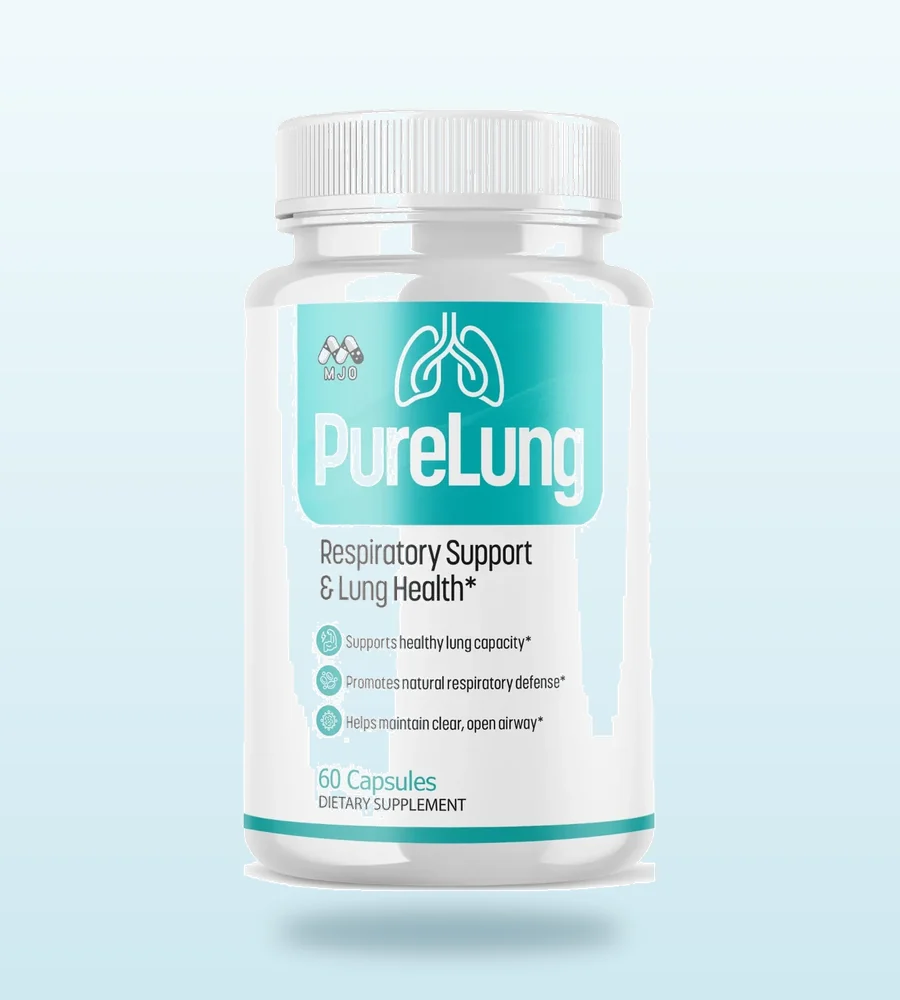
Pink salt is the first ingredient in PureLung's blend
Under the descending-order rule that makes it the heaviest component. See what else the panel shows.
Read the PureLung Review